The retirement questions that keep Australians awake at night
Will you have enough? When can you retire? How much can you safely spend?

Ad - Before we start — a big thanks to our podcast sponsor this week, Brighter Super

Advice for every member, every step of the way
Retirement is one of life’s biggest financial decisions, and the choices you make today can have a lasting impact on your future.
That’s why Brighter Super is making financial advice simpler, more accessible and more affordable for every member.
Whether you’re growing your super, planning for retirement or simply want to understand your options, our super specialists can help you make confident and informed decisions.
Retirement advice doesn’t have to start with a complex financial plan. Start by using Brighter Super’s What Age Can I Retire? Calculator to see how your current super balance and retirement goals could influence when you’re able to retire.
Brighter Super Trustee as Trustee for Brighter Super. Brighter Super products are issued by the Trustee on behalf of the Fund. Consider the PDS & TMD before deciding if Brighter Super is right for you, at brightersuper.com.au/pds
The retirement questions that keep Australians awake at night
One of the things I’ve learnt after thousands of conversations with people over the years is that most Australians aren’t lying awake at night wondering whether they should have 60% or 70% invested in growth assets.
They’re asking much bigger questions: Will I have enough? When can I stop working? How much can I safely spend? What happens if markets fall? Am I making a mistake?
The problem is that most people start with their super balance and hope it’ll somehow give them the answers. But I think we should start with our life instead.
In this week’s episode of Prime Time, I work through some of the biggest retirement questions I hear every day and share the practical exercises that can help you answer them with confidence.
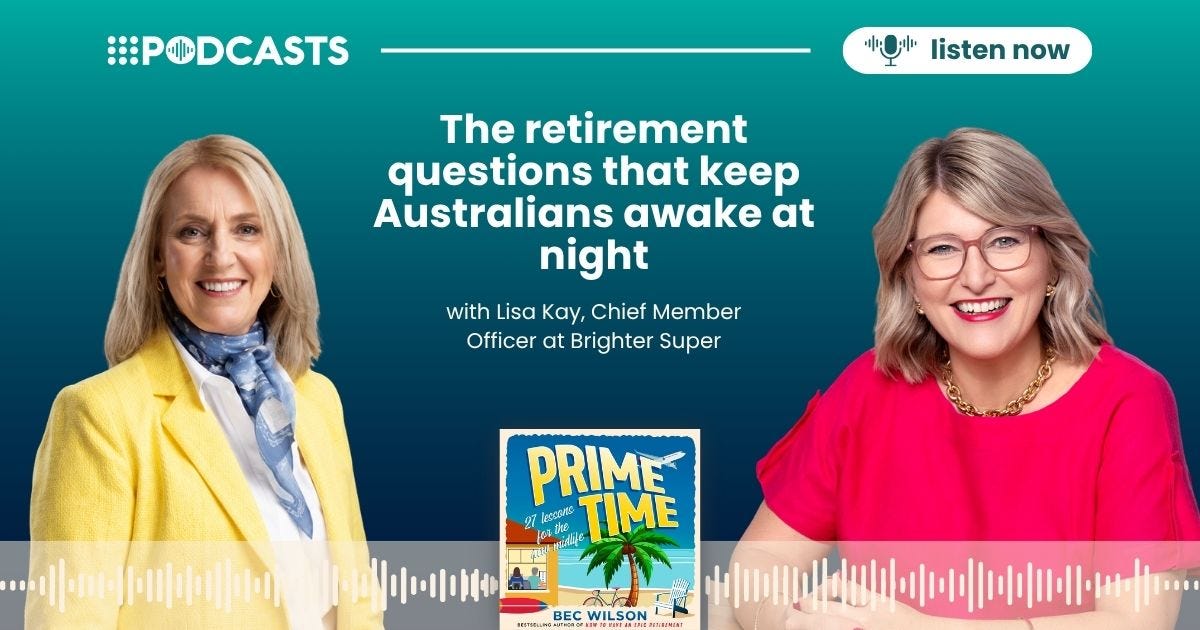
I’m also joined by Lisa Kay, Chief Member Officer at Brighter Super, to discuss why getting guidance doesn’t have to mean signing up for a comprehensive financial plan. Sometimes it’s simply about asking the right questions at the right time and knowing where to go for help.
Retirement isn’t one big decision. It’s a series of decisions made over many years. And the earlier you start asking the right questions, the more choices you’ll have when the time comes.
LISTEN TO THIS EPISODE OF THE PODCAST HERE:
Highlights of the conversation:
Start with your life, not your super: Why retirement planning should begin with the lifestyle you want to live.
Retirement isn’t a cliff edge: A different way to think about leaving full-time work that could bring retirement closer than you think.
Spending with confidence: A simple framework for managing your money throughout retirement.
Planning for the unexpected: How to prepare for market downturns without derailing your retirement plans.
Advice isn’t all or nothing: Why getting guidance can be simpler, more affordable and more accessible than many people realise.
Making the most of your super fund: Lisa Kay explains the types of support and retirement guidance members can access.
The biggest retirement mistakes: The common planning traps I see people fall into, and how to avoid them.
From Bec’s Desk
Happy Prime Time podcast day!
This week I really wanted to talk about the things that keep people awake at night as they approach retirement. Alongside that, I want to spend a lot more time exploring financial advice – the different types available, what each is designed to do, and the expectations you should have of each.
That’s why I was thrilled to have Lisa Kay from Brighter Super join me on the podcast. Last month, Brighter Super won Chant West’s Best Advice Services award for 2026, and I wanted to dig into what that actually means in the real world. What does it look like when a super fund delivers great advice? And what does an award like this tell us about where advice is heading and the role your fund can play in helping you prepare for retirement?
This week I’ve been on the road, in chilly Sydney and Melbourne – speaking about rightsizing and chatting with superfunds too. It’s nice to get out and about and hear what the funds are improving, what projects are being prioritised, and how retirement is shifting, and I’m grateful the funds make time to sit down and chat about these things.
And we’ve been working on our next Epic Retirement Flagship Course which is launching in less than 4 weeks. We’ve launched a completely new technology platform, and continued to improve the learning experience. I’m thrilled that it just keeps getting better and better. The 25% off deal has a about 20 places left. So, if you’ve been thinking about joining us in August – don’t delay.
Hop on over to our new website at epicretirement.net/course-au where you can download a brochure and learn more about the course; and book your place.
Hope you enjoy the show.
Thanks for listening! Cheers Bec Xx